
Our service offerings
Four services take organisations from diagnosis to operation: advise, build, coordinate and align. Each engagement produces usable decisions, delivered systems or evidence that teams can take forward.
Advise
We conduct data and AI audits, assess existing systems and clarify strategy, governance and scope. The engagement turns findings into a prioritised roadmap, explicit options and decisions ready for the client to make. Targeted workshops enable teams to understand the trade-offs and act on them.
Build
We build and can operate the data and AI systems shown below, assembled from open-source components and adapted to the client’s environment. We hand over code, documentation and procedures. Training and operational workshops prepare teams to maintain and evolve what has been delivered.
Coordinate
We coordinate technical delivery across national and European multi-partner projects, bringing public and private partners around a shared design, integration, deliverables and technical reviews. We establish decisions that partners can implement and evidence they can review. Working sessions and training keep interfaces aligned and enable teams to operate the result.
Align with European frameworks
We assess data and systems against European frameworks for FAIR data, catalogues, vocabularies and the AI Act. Because we help write shared recommendations, we turn them into concrete changes to governance, metadata, interfaces and evidence. Workshops and training help teams sustain that alignment.

Advise
We help organisations understand their current position, make explicit choices and define a path they can implement. Each engagement turns analysis into documented decisions, practical deliverables and a shared understanding of what comes next.
Data & AI audit
We examine data assets, flows, systems, AI uses, governance and operating practices against the organisation’s objectives. Interviews and technical reviews identify strengths, gaps, risks and dependencies. The client receives a documented assessment, prioritised findings and a restitution workshop for deciding what to address first.
Strategy and roadmap
We translate organisational priorities into data and AI objectives, use cases and a realistic sequence of work. Working sessions compare scenarios, clarify trade-offs and establish the conditions for delivery. The client receives a strategic brief, a prioritised roadmap and a decision register with owners and next steps.
Data & AI governance
We define responsibilities, decision rights, policies and controls for data and AI throughout their lifecycle. Workshops bring operational, legal, scientific and technical stakeholders around the same rules and escalation paths. The client receives a governance model, role definitions, decision processes and controls that teams can apply and review.
Scoping and technical choices
We turn a need into a bounded scope, explicit requirements, a target design and an implementation approach. Technical workshops compare options against existing systems, skills, risks, costs and operating constraints. The client receives a scoping document, documented choices, acceptance criteria and an actionable delivery plan.
Build
We design, deliver and operate data and AI systems adapted to the client’s existing environment and responsibilities. The two diagrams below show the open components and reusable building blocks from which we construct them.

Design and setup
We turn an approved scope into a detailed design, working environments and the foundations of an operable system. Design reviews and short implementation cycles keep technical choices aligned with user needs and operating constraints. The client receives the design, configured environments, initial components and an updated delivery plan.
Development and integration
We develop data flows, knowledge graphs, search services and AI that links its answers to supporting sources. We integrate these components with existing systems and verify their behaviour through automated tests and review demonstrations. The client receives tested code, documented interfaces, integration procedures and evidence for acceptance.
Operations and monitoring
We put systems into operation with monitoring, logging, alerting, backup, recovery and capacity management designed in from the start. Operational reviews use observed behaviour to improve performance, resilience and support procedures. The client receives dashboards, alerts, runbooks, recovery procedures and an explicit division of operational responsibilities.
Handover and training
We hand over code, configuration, documentation and operating knowledge as part of the delivery. Walkthroughs, practical workshops and training use the delivered system rather than a generic demonstration. Client teams learn to deploy, monitor, troubleshoot and evolve it without depending on an imposed provider.
Open reference architectures for data and AI
We use two open reference architectures to turn data and AI needs into systems that can be built and operated. They combine proven open-source components with reusable Foxcub accelerators. Code, documentation and operating procedures are handed over to the client, with no Foxcub licence fee, proprietary lock-in or imposed provider.
DATA REFERENCE ARCHITECTURE
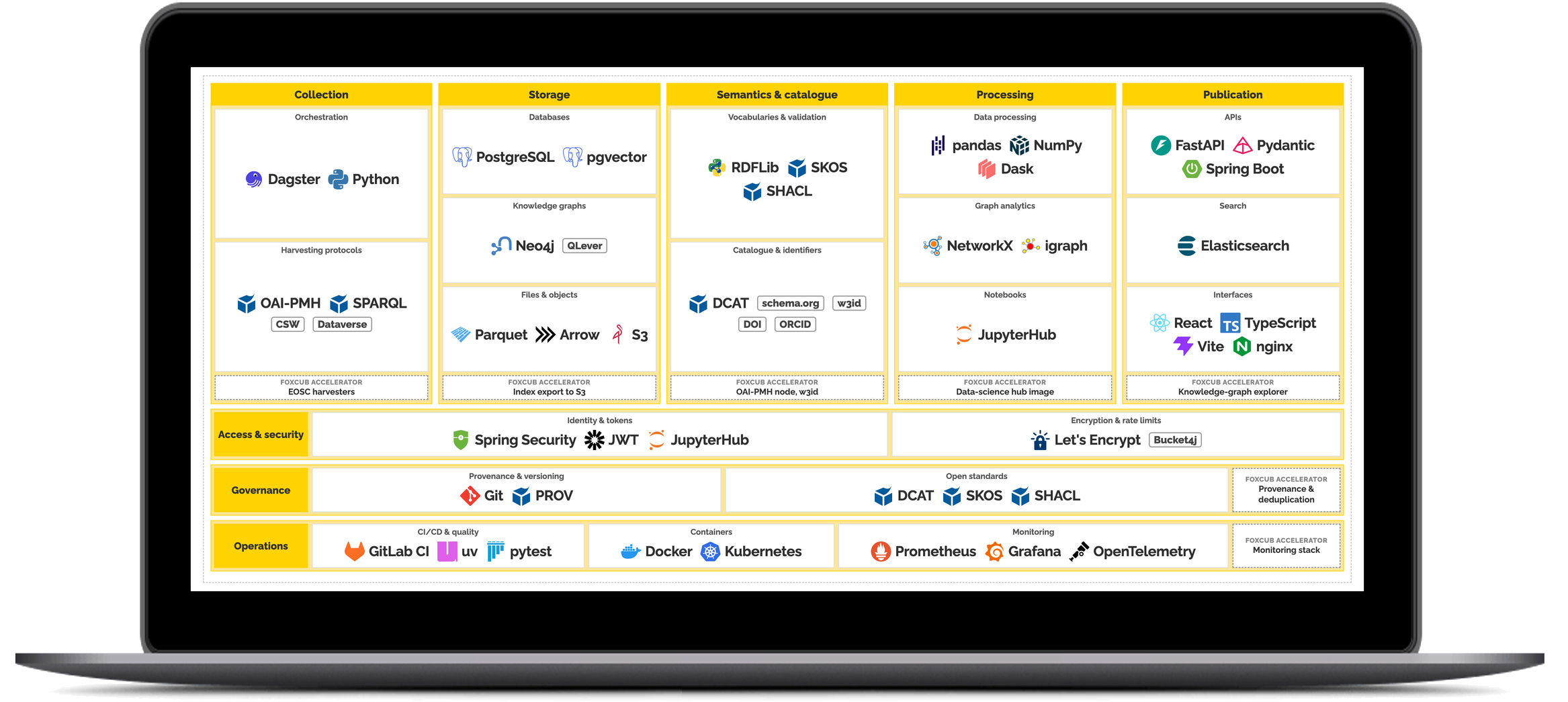
From distributed sources to linked, governed data ready for reuse and delivery.
The architecture adapts to existing systems and operating constraints instead of imposing a fixed stack. It brings collection, storage, semantics, processing and publication into one coherent system, supported by security, governance and operations. Each component can be replaced as needs evolve.
AI REFERENCE ARCHITECTURE
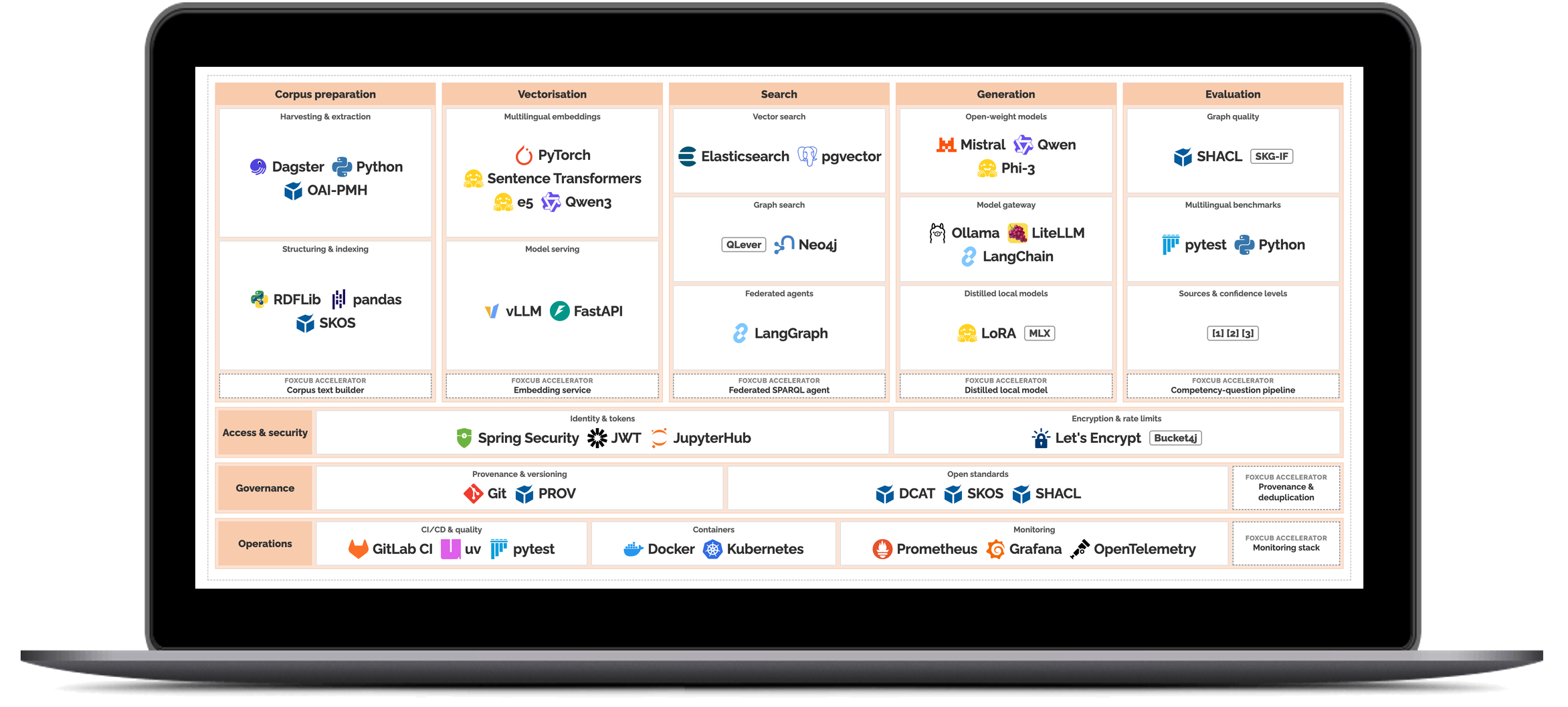
AI grounded in your data, with every answer linked to the sources that support it.
The architecture links corpus preparation, vectorisation, search, generation and evaluation in a traceable chain. Sources and access rules remain visible from input to answer, and evaluation is built in before production. Models and components remain replaceable.
Technical coordination of collaborative projects
We organise the technical work of national and European multi-partner projects, bringing autonomous public and private partners around one coherent result. The service covers shared decisions, integration, dependencies, evidence and reviews from the initial framework to final handover.
Shared technical framework
We turn the objectives and constraints of public and private partners into a shared design, clear interfaces and documented decisions. Deliverables can include a target design, interface contracts, a decision register and an integration plan. Framing workshops ensure that each partner understands what it must provide and what it can depend on.
Integration and delivery
We track dependencies, prepare integration paths and verify that components work together before formal reviews. The client receives integration criteria, test evidence, release documentation and a clear view of unresolved risks. Technical sessions resolve issues with the partners who own them.
Technical governance and reviews
We prepare technical boards and reviews around decisions, evidence, risks and acceptance criteria. Progress is reported in terms that programme leaders and engineering teams can both use. This creates an auditable path from an agreed objective to a reviewed deliverable.
Handover and shared capability
Documentation, demonstrations and training are produced as part of delivery rather than added at the end. Partners learn how to use the shared interfaces, reproduce the checks and operate their part of the system. The consortium retains the knowledge needed to continue after handover.

European interoperability and compliance
We translate European data and AI frameworks into requirements that can be designed, implemented and verified. The service identifies gaps, defines the target alignment and produces the technical and governance evidence needed to sustain it.
Readiness and gap assessment
We review governance, data models, catalogues, interfaces, access rules and AI uses against the applicable European framework. The assessment distinguishes mandatory requirements, shared recommendations and improvement choices. The client receives a documented gap analysis, priorities and decisions to make.
FAIR data and interoperability
We align catalogues, vocabularies, metadata and exchange mechanisms so that data remains findable, accessible under explicit conditions, interoperable and reusable. Deliverables can include target profiles, mapping rules, validation criteria and an implementation plan. Working sessions transfer the reasoning behind each choice.
AI compliance by design
We translate the AI Act and related data, copyright and traceability obligations into system requirements. The work covers source attribution, provenance, access controls, human oversight, evaluation and abstention when evidence is missing. The client receives design decisions, control points and evidence requirements that can be tested.
Remediation and evidence
We implement or supervise the changes required in governance, metadata, interfaces and operating procedures. Validation rules, test results, decision records and updated documentation form an evidence package that can be reviewed and maintained. Training enables client teams to apply the controls to later changes.
Would you like more information? We’re available to discuss it with you.